
Green lipped mussel is well known for supporting joint health and mobility in dogs; but not all GLM supplements are the same. Discover what makes this New Zealand mussel so special, the difference between green lipped mussel oil and powder, and why sourcing, processing and concentration can make a difference.
Green-lipped mussel has become one of the best-known natural joint supplements for dogs, particularly for older dogs, active dogs and those needing additional mobility support. But if you have ever compared green-lipped mussel supplements, you may have noticed considerable differences between products.
Some contain green-lipped mussel powder, while others use a concentrated green-lipped mussel oil or lipid extract. The quality, source and processing methods can also differ considerably.
So, what exactly makes New Zealand green-lipped mussel special, what is the difference between the oil and powder, and why does the way it is produced matter?
What is Green-Lipped Mussel?
Green-lipped mussel (Perna canaliculus) is a species of mussel native to New Zealand. It naturally contains a complex range of nutrients associated with joint health, including omega-3 fatty acids and, in whole-mussel powders, naturally occurring glycosaminoglycans (GAGs).
Unlike conventional fish oils, green-lipped mussel contains a particularly diverse lipid profile. Alongside the familiar omega-3 fatty acids EPA and DHA, green-lipped mussel lipid extracts contain unusual long-chain omega-3 fatty acids including ETA (eicosatetraenoic acid) and a wider natural matrix of fatty acids.
This is an important distinction: green-lipped mussel oil isn't simply another type of fish oil.
How Can Green-Lipped Mussel Support Your Dog's Joints?
One of the main reasons green-lipped mussel is used in joint supplements is its naturally occurring marine lipids. Research into green-lipped mussel lipid extracts suggests that some of these compounds may influence inflammatory pathways, including both the cyclooxygenase (COX) and lipoxygenase (LOX) pathways. This is particularly interesting because most non-steroidal anti-inflammatory drugs (NSAIDs) act primarily on the cyclooxygenase pathway, whereas research into green-lipped mussel lipid extracts has described activity across both COX and LOX pathways.
Inflammation is an important contributor to the discomfort and reduced mobility associated with joint conditions, which helps explain the considerable interest in green-lipped mussel for dogs with age-related joint problems.
There is also clinical research in dogs. In one double-blind, placebo-controlled study involving 81 dogs with degenerative joint disease, a higher proportion of dogs receiving green-lipped mussel extract showed improvement after 56 days compared with placebo. Other controlled studies have similarly reported improvements in measures of mobility or chronic orthopaedic pain.
Green-lipped mussel should, however, be regarded as a nutritional supplement rather than a treatment or cure for arthritis, and dogs experiencing pain, lameness or significant changes in mobility should always be assessed by their vet.
What Makes Green-Lipped Mussel Different from Fish Oil?
Both fish oil and green-lipped mussel can provide beneficial omega-3 fatty acids, but they aren't interchangeable. Fish oils are principally valued as sources of EPA and DHA. Green-lipped mussel lipid extracts provide EPA and DHA too, but also contain additional fatty acids including ETA, alongside numerous other fatty acids within the mussel's natural lipid matrix.
Research into GLM lipid fractions has reported particularly interesting anti-inflammatory activity. One frequently quoted study found a green-lipped mussel lipid fraction considerably more potent than fish oil in the experimental models used.
This doesn't mean that every green-lipped mussel supplement is clinically better than fish oil. Rather, it highlights that green-lipped mussel has a distinctly different lipid profile and biological activity from conventional fish oils.
Green-Lipped Mussel Oil vs Green-Lipped Mussel Powder – What's the Difference?
This is probably one of the most important distinctions to understand when choosing a green-lipped mussel supplement. Although both come from Perna canaliculus, an oil extract and a whole-mussel powder provide different concentrations of its naturally occurring compounds.
Green-Lipped Mussel Oil – Concentrated Lipid Support
Kōrure Pets' Marine Phospholipid Oil (MP Oil) concentrates the lipid fraction of New Zealand green-lipped mussels. According to Kōrure, a clinical study shows its oil contains more than 30+ fatty acids, including EPA, DHA and ETA, is 100 times more potent than fish oil and 125 times more concentrated than fresh mussel and 247 times more potent than salmon oil. As a result od the lipid fraction is so concentrated, only a very small amount is required. This makes the oil particularly useful where concentrated omega-3 and joint support is required.
Kōrure's MP Oil is produced using supercritical CO₂ extraction, which concentrates the bioactive lipid fraction without leaving solvent residues. The resulting extract is carried in olive oil, which helps maintain its stability.
So, you only need a few drops and there is no fishy odour for fussy pets.

Green-Lipped Mussel Powder – Whole-Mussel Cartilage Support
Kōrure Pets' Green-lipped mussel powder retains more of the components of the whole mussel. One important difference is its naturally occurring glycosaminoglycan (GAG) content. GAGs are structural components found naturally within cartilage and connective tissues and are therefore of particular interest when looking at longer-term cartilage and joint support.
Kōrure describes its Marine Phospholipid Powder as its everyday option for supporting cartilage, flexibility and long-term joint health, whereas its concentrated oil is primarily positioned for stronger lipid-based joint and mobility support.

In simple terms:
- Kōrure's GLM Oil = concentrated marine lipids, omega-3s and mobility support
- Kōrure's GLM Powder = whole-mussel nutrition, including naturally occurring GAGs for cartilage and joint support
The two can also be given together where broader joint support is required.
Why Does the Quality of Green-Lipped Mussel Matter?
Not all green-lipped mussel supplements are necessarily equivalent. The beneficial lipids found within green-lipped mussels are vulnerable to oxidation, so where the mussels are grown and how quickly and carefully they are processed can influence the finished ingredient.
Kōrure Pets uses Perna canaliculus grown in New Zealand. None of the mussels are imported from other countries. The company states that its mussels are harvested from locations around New Zealand's South Island, with much of its supply coming from Banks Peninsula, an area rich in the algae on which the mussels feed. The oil is then produced from the mussels using supercritical CO₂ extraction to concentrate the lipid fraction. This combination of New Zealand provenance, traceability and controlled extraction is why this range of green-lipped mussel products from Kōrure Pets is such a great addition to the range.
What is Supercritical CO₂ Extraction?
It sounds rather technical, but it is worth understanding. Supercritical carbon dioxide can be used to extract oils and other lipid-soluble compounds without the conventional chemical solvents used in some extraction processes.
For green-lipped mussel, the process enables the valuable lipid fraction to be separated and concentrated. Kōrure states that its resulting extract is around 125 times more concentrated than fresh mussel meat. That is also why the serving size of a concentrated mussel oil can look surprisingly small compared with a powder or conventional omega-3 oil – you're giving a concentrated lipid extract rather than whole mussel.
What About ETA?
EPA and DHA are probably familiar if you already give your dog an omega-3 supplement, but ETA (eicosatetraenoic acid), is much less well known. ETA is one of the unusual fatty acids associated with green-lipped mussel and is one of the features that distinguishes its lipid profile from conventional fish oil.
Laboratory research has identified a family of unusual omega-3 polyunsaturated fatty acids within Perna canaliculus and investigated their ability to influence the production of inflammatory mediators such as leukotrienes.
The precise mechanisms are still being investigated, so it is better to think of ETA as one part of green-lipped mussel's unusually complex lipid matrix rather than as a single "magic" ingredient.
Is There Research Behind Green-Lipped Mussel?
Yes, although it is important to put the research into context. Green-lipped mussel has been investigated in laboratory studies, animal models and clinical trials, including studies involving dogs with joint problems.
Research has reported potential benefits for measures including joint pain, mobility and signs associated with degenerative joint disease. However, different studies have used different preparations, including powders, lipid extracts and GLM-enriched foods, so the results of one study cannot automatically be applied to every green-lipped mussel product.
Kōrure has also undertaken analytical work with the University of Otago. In a small human study, unsaturated fatty acids in plasma increased significantly four hours after two Kōrure capsules. This is interesting evidence that components of the product were absorbed, although importantly, this was a bioavailability study rather than a trial demonstrating a clinical improvement in joint health.
Oil or Powder: Which Should I Choose for My Dog?
There isn't necessarily a single right answer because the two formats have different nutritional profiles. For a dog needing concentrated omega-3 and mobility support, a high-quality green-lipped mussel oil may be the most appropriate choice.
For everyday joint and cartilage support, a whole green-lipped mussel powder provides a broader range of naturally occurring components, including GAGs.
For dogs needing more comprehensive support, oil and powder can also complement one another, providing both concentrated marine lipids and the whole-mussel compounds associated with cartilage health.
This distinction is one of the reasons we particularly like the Kōrure Pets range: rather than treating all green-lipped mussel supplements as the same, it provides different formats depending upon the type of nutritional support required.
A table showing the difference between MP powder and MP Oil
|
Feature |
Marine Phospholipid Oil |
Marine Phospholipid Powder |
|
Strength on joints |
***** |
*** |
|
Longevity |
**** |
***** |
|
Main benefit |
Powerful joint support |
Cartilage repair support |
|
Omega-3 content |
***** 30+ Essential Fatty Acids including Omega 3 (EPA, DHA, ETA & More) |
** |
|
GAGs content |
***** |
|
|
List of ingredients |
New Zealand Green Lipped Mussel Oil, Natural Olive Oil, Vitamin E |
New Zealand Green Lipped Mussel Powder |
So the oil helps with the joints whereas the powder helps with the cartilage around the joints. Taking them together helps prevent joint issues and help with recovery.
Kōrure Pets Dog Honey – Joint & Immune Support
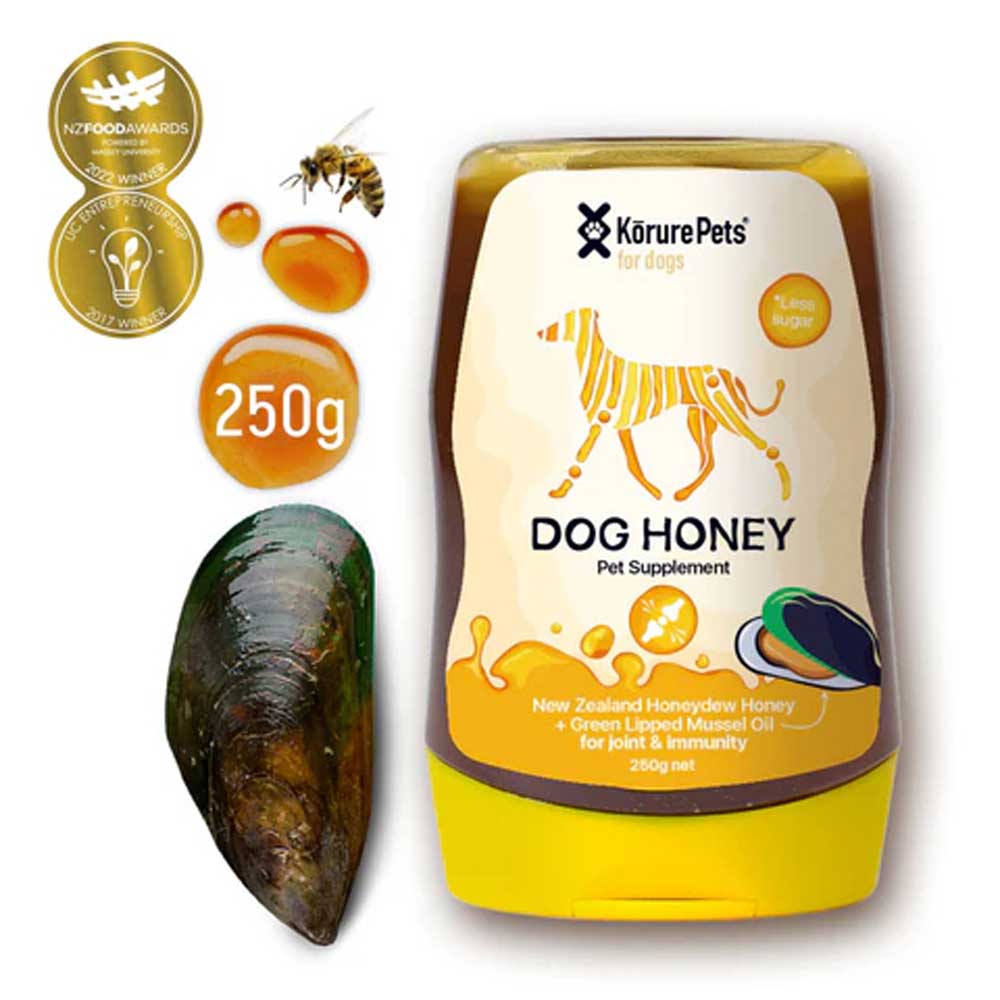
For something a little different, Kōrure Pets Dog Honey combines New Zealand honeydew honey with Kōrure's concentrated Green-Lipped Mussel Oil to provide support for both joint health and immunity.
The Green-Lipped Mussel Oil provides a naturally rich source of marine fatty acids, including omega-3 EPA, DHA and ETA, to support healthy joints and mobility. This is blended with New Zealand honeydew honey to create a tasty, easy-to-feed supplement that can simply be added to your dog's food.
Kōrure uses minimally processed honeydew honey which retains its naturally occurring components, making Dog Honey an interesting choice for dogs needing broader everyday support alongside the joint benefits of green-lipped mussel.

The Kōrure Pets Difference
When choosing a green-lipped mussel supplement, don't simply look for "GLM" on the ingredients list.
Consider:
- Where the mussels originate
- Whether the product contains whole mussel powder or a concentrated lipid extract
- How the mussels are processed
- The omega-3 and wider fatty-acid profile
- Whether the product naturally supplies GAGs
- Traceability and quality control
- How much actual green-lipped mussel ingredient is provided
Kōrure Pets specialises in New Zealand marine supplements and has built its range around New Zealand green-lipped mussel. Its MP Oil provides a highly concentrated source of marine lipids, while its MP Powder retains the naturally occurring GAGs and other constituents of the whole mussel.
Rather than asking whether oil or powder is "better", it can therefore be more useful to ask what you want the green-lipped mussel to provide for your dog.
For some dogs that will be concentrated lipid and omega-3 support; for others it will be everyday cartilage and joint nutrition – and sometimes there is a place for both.


